Are you or your child struggling with a brain based disorder?
Our highly effective, safe, and drug-free programs are based on the latest findings in neuroscience. This approach,
called BrainCore Neurofeedback Therapy, is an advanced form of biofeedback that has been used successfully for a wide range
of learning and brain-based disorders.
For over 45 years, neurofeedback has proven to be the best
drug-free, all natural method for safely and permanently alleviating attention, learning and behavioral issues. Neurofeedback
works on the source of the problem, not just the symptoms.
What Is Braincore Neurofeedback?
Neurofeedback helps children and adults safely train
and “rewire” the brain by helping balance dysfunctional brainwave activity, thereby restoring normal cortical
functioning. The key to understanding Neurofeedback is to first understand the root cause of these symptoms: Neurological
Dysregulation Syndrome (NDS).
Neurological
Dysregulation Syndrome is a brainwave imbalance that prevents the brain from functioning at its full capacity. A healthy,
optimally functioning brain needs balance and synergy, just like a symphony orchestra.
Imagine how the music would sound if the musicians all played at the
wrong time? Or if each musician played their part incorrectly? What would it sound like if the instruments were not
in tune? Or if they played at the wrong volume? If any one of these is true, the resulting music will not sound like
it should. This is what is happening when there is Neurological Dysregulation, the brainwaves are not playing together in
harmony.
Neurofeedback can
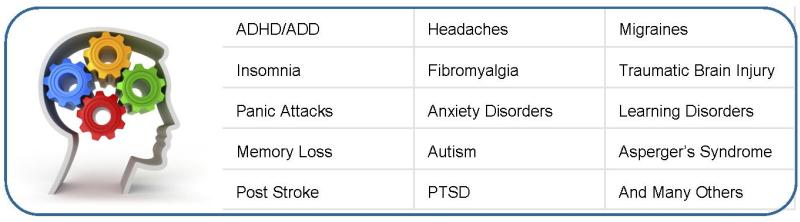
successfully improve a number of disorders at the same time, such as head injuries,
addictions and co–occurring disorders such as learning disabilities, memory
loss, behavioral problems, mental health and behavioral disorders.The reason
for this is very simple... all
neurological disorders originate in the brain.
The Quantitative EEG
Neurofeedback training begins first with a consultation.
If your case qualifies for further evaluation, we would perform a Quantitative Electroencephalogram or QEEG for short. The
QEEG will record and analyze the brainwaves and determine if any neurological dysregulation exists. We need to measure if
the brainwaves are being produced in the right areas of the brain, in the right amounts, proportions and types.
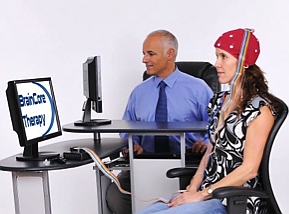
This is done by placing a special sensor cap on the head and filling the holes with a little gel. This
cap is then connected to the QEEG equipment, and the brainwaves are measured with both the eyes open and closed.
This process takes 20-30 minutes. It is important to remember that this is non-invasive and the
cap is only sensing the brain's activity. The resulting data is uploaded to a national database
that has over fifty thousand brainmap recordings for comparison purposes. On your subsequent
visit, we will determine if the symptoms discussed during consultation are the result of objective EEG dysregulation
or some potential other factors. If you qualify for treatment, a customized training protocol is designed
just for your case. This is not a one size fits all therapy.
How is Neurofeedback Performed?
Neurofeedback training is performed in the office while connected to the same EEG equipment,
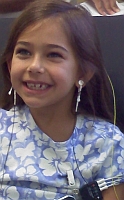
however instead of a multi-sensor cap, 2 individual sensors that are smaller than a dime are placed
on specific training sites determined by your brain map as well as a clip on each ear lobe.
The
computer monitors the brainwaves in real time, and when the brain is producing the proper brainwaves,
in the way the computer is expecting, the patient receives a positive reward. This is where
the fun comes in. Most often, training is done with the aid of a movie. The movie itself isn't important, but what is
important is that the movie will only play when the correct brainwave is being produced. The patient
is only asked to pay attention to their state of mind that makes the movie play. This will trigger
the brain to "re-wire" itself in a manner that is more efficient in producing the desired brainwaves. The kids love it!
Research Supported and Evidence Based
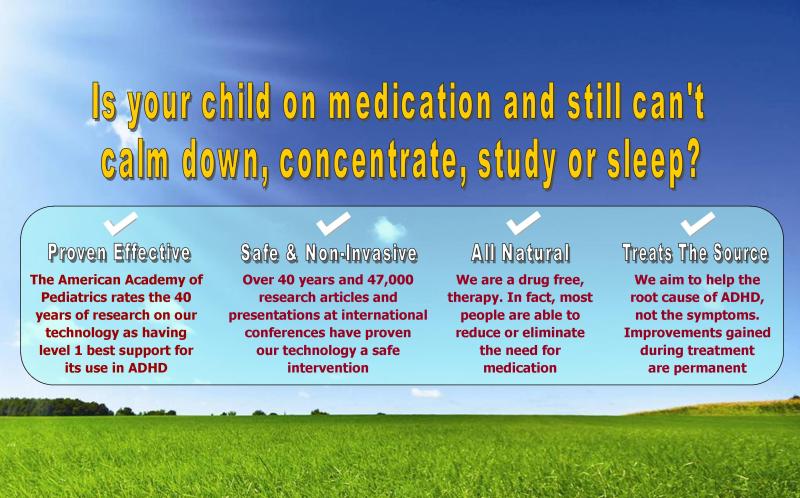
The American Academy of Pediatrics is
the governing credentialing board of 60,000 primary care pediatricians and specialists. They rate Neurofeedback as having
level 1 best support for its use in Attention Deficit Disorder. This means that
neurofeedback is the first non-pharmacological treatment suggested for ADHD. In fact, over 125 published
research studies have shown neurofeedback's effectiveness in helping Attention Deficit Disorder.
The US government
also agrees! The FDA recently approved the use of brainwave measurements of Theta and Beta bands
as indicators to aid in the diagnosis of ADHD.
The US military and NASA use neurofeedback to provide peak performance training.
This optimal performance training is used in over 20 military bases prior to deployment to forward
combat zones.